Period: Late 18th century
Provenance: Italy
Dimensions (cameo): 22 mm
Ring size: 7
Weight: 18 gr
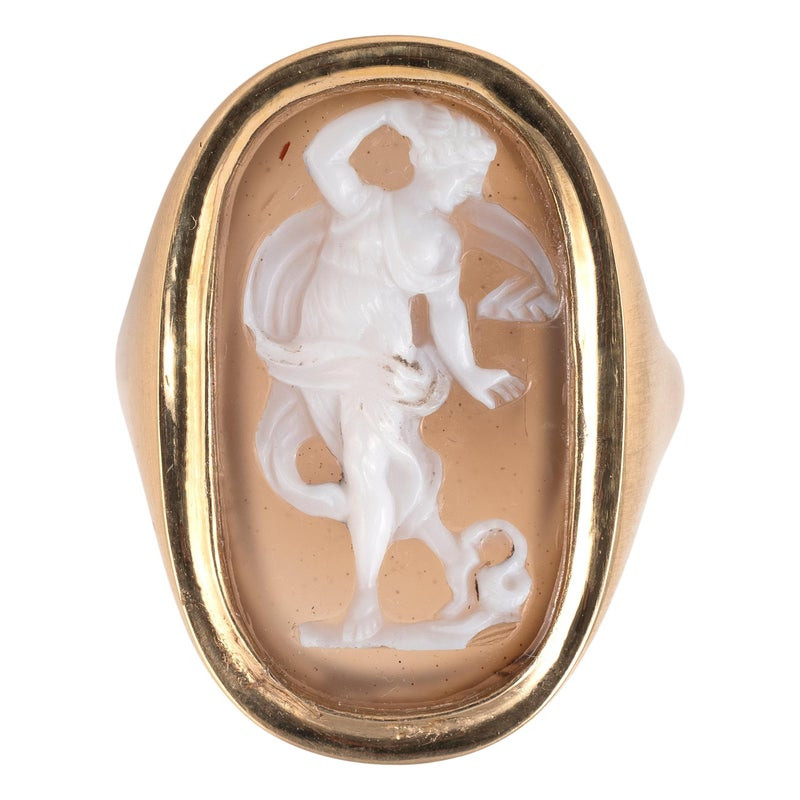
Questo cammeo della fine del XVIII secolo è realizzato in agata e inserito in una montatura in oro 18 carati essenziale ma funzionale a valorizzare al meglio la raffigurazione centrale. Al centro, infatti, il cammeo ritrae Euridice, ninfa figlia di Apollo e sposa di Orfeo, la quale morì precocemente a causa del morso di un serpente nel mentre fuggiva per sottrarsi alle attenzioni indesiderate del pastore Aristeo. Orfeo, il quale era un poeta, iniziò ad intonare canti disperati con la sua lira, tanto da commuovere tutti gli dèi che gli consigliarono di recarsi negli Inferi per convincere Ade e Persefone a riportargli la sua amata. Orfeo riuscì ad ottenere ciò che desiderava, ma soltanto a patto che Orfeo – nel tragitto che li avrebbe nuovamente condotti al regno dei vivi – camminasse davanti ad Euridice senza mai girarsi. Orfeo rispettò il patto fino a che arrivarono alla fine, quando furono inondati da una luce abbagliante che indusse il poeta a girarsi per assicurarsi che l’amante lo stesse seguendo e, a quel punto, Euridice venne trascinata nuovamente nel regno dei morti. Il cammeo, però, raffigura il momento iniziale di questo mito, ovvero quando Euridice sta per essere morsa dal serpente che si scorge ai suoi piedi e verso cui la fanciulla sembra rivolgere uno sguardo sorpreso, sebbene il suo movimento e il panneggio conferiscano un aspetto teatrale e lirico alla scena.
This cameo of the late eighteenth century is made of agate and inserted in an essential but effective 18 carat gold frame to enhance the central representation. In the center, in fact, the cameo portrays Eurydice, nymph daughter of Apollo and wife of Orpheus, who died prematurely due to the bite of a snake while fleeing to escape the unwanted attention of the pastor Aristeo. Orpheus, who was a poet, began to sing desperate songs with his lyre, so much to touch the heart of all the gods who advised him to go to the Underworld to convince Hades and Persephone to bring back his beloved. He managed to get what he wanted, but only on the condition that Orpheus – in the journey that would take them back to the kingdom of the living – walked before Eurydice without ever turning around. Orpheus kept the pact until they arrived at the end, when they were flooded with a dazzling light that induced the poet to turn around to make sure that Eurydice was following him and, at that point, Eurydice was dragged back into the Hades. The cameo, however, represents the initial moment of this myth, that is when Eurydice is about to be bitten by the snake that you see at her feet and towards which the girl seems to turn a surprised look, although its movement and draping give a theatrical and lyrical look to the scene.


You might also like
Period: Late 18th century
Provenance: Italy
Dimensions (cameo): 22 mm
Ring size: 7
Weight: 18 gr