

Description
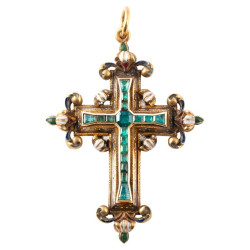
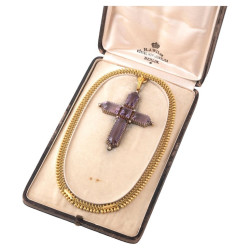
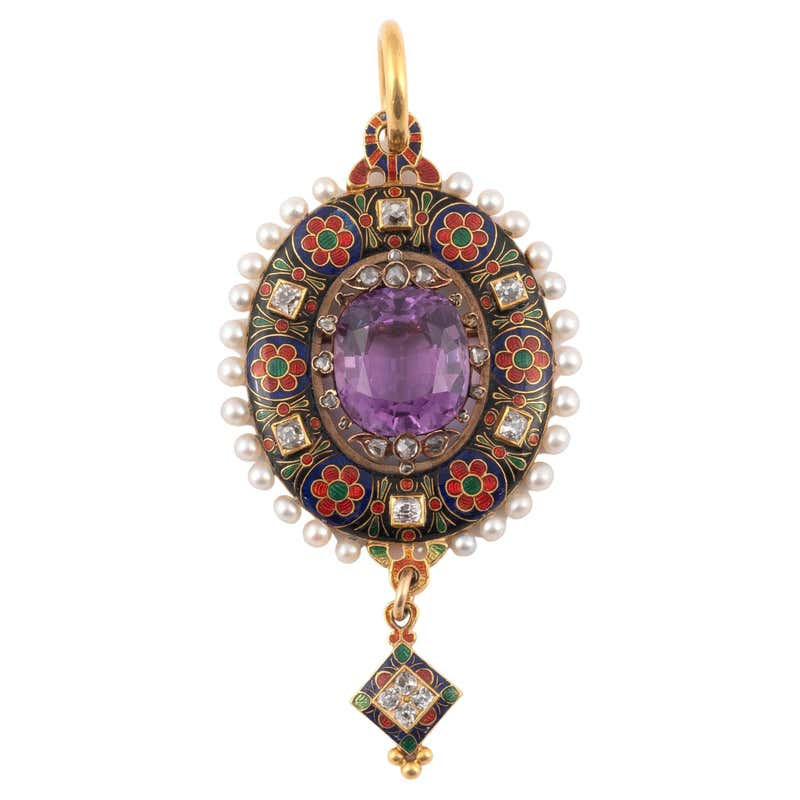
Questo pendente in oro giallo, in stile Holbein, è caratterizzato da un’ametista siberiana centrale di approssimativamente 10 carati, contornata da diamanti taglio rosa e smalti cloisonné policromi, impreziositi da ulteriori diamanti taglio rosa, mentre la profilatura esterna del pendente è caratterizzata da minute perle naturali; la parte inferiore, invece, è completata da un pendente di forma quadrata in cui ritornano i diamanti e gli smalti cloisonné. Il retro del pendente, tuttavia, merita ugualmente attenzione giacché è finemente inciso con un motivo di arabeschi che conferisce ulteriore preziosità all’oggetto. Lo stile Holbein, di cui questo pendente ne è un esempio, prende le mosse dagli originali disegni di gioielli del pittore tedesco Hans Holbein il Giovane (1497 – 1543), pittore di corte del re Enrico VII, i quali ispirarono i gioielli neorinascimentali che si diffusero a partire dagli anni Sessanta del XIX secolo, in particolar modo dopo l’Esposizione Internazionale che si tenne a Londra nel 1862. Hans Holbein il Giovane, però, non ha solamente impreziosito i suoi quadri con questi fastosi gioielli, bensì ha lasciato in eredità una serie di disegni preparatori che dimostrano lo studio e l’attenzione riposta nel rappresentare questi preziosi oggetti che spesso adornano giovani donne, di cui alcuni esempi sono conservati al British Museum: SL, 5308.107; SL, 5308.93; SL, 5308.129. Altri esempi di gioielli in stile Holbein e neorinascimentale, invece, sono conservati presso il Victoria & Albert Museum di Londra: CIRC.95-1961; IS.359-1992.
This yellow gold Holbeinesque pendant is characterized by a central Siberian amethyst of approximately 10 carats, surrounded by rose cut diamonds and polychrome cloisonné enamels, embellished with further rose cut diamonds, while the external profiling of the pendant is characterized by minute natural pearls; the lower part, however, is completed by a square-shaped pendant in which the diamonds and cloisonné enamels return. The back of the pendant, however, still deserves attention as it is finely engraved with an arabesque motif which gives further preciousness to the object. The Holbein style, of which this pendant is an example, is inspired by the original jewellery designs of the German painter Hans Holbein the Younger (1497 – 1543), court painter to King Henry VII, which inspired the neo-Renaissance jewellery that spread from the sixties of the 19th century, especially after the International Exhibition which was held in London in 1862. Hans Holbein the Younger, however, not only embellished his paintings with these sumptuous jewels, but rather left a legacy of a series of preparatory drawings that demonstrate the study and attention paid to representing these precious objects that often adorn young women, of which some examples are preserved in the British Museum: SL, 5308.107; SL, 5308.93; SL, 5308.129. Other examples of Holbein and neo-Renaissance style jewellery, however, are preserved at the Victoria & Albert Museum in London: CIRC.95-1961; IS.359-1992.
Details
Period: 1865
Provenance: United Kingdom
Dimensions: 7,5 x 3,8 cm
Weight: 15,93 gr
You might also like
Period: 1865
Provenance: United Kingdom
Dimensions: 7,5 x 3,8 cm
Weight: 15,93 gr