

Description
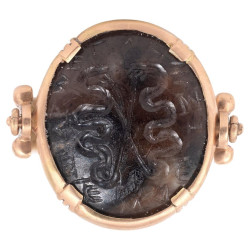
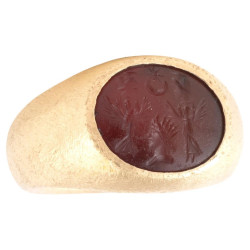
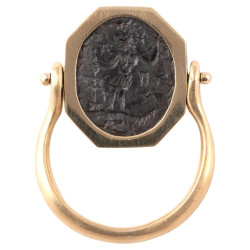
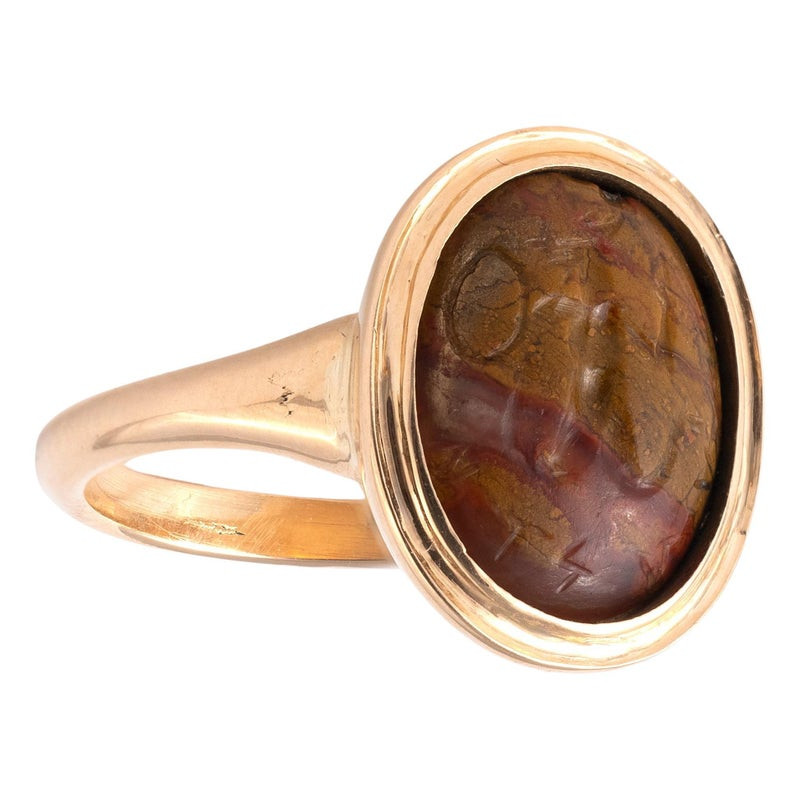
Questo anello magico di epoca romana, risalente al II secolo circa, è caratterizzato da una semplice montatura contemporanea in oro volta a valorizzare l’intaglio centrale in diaspro, in cui è incisa una raffigurazione di Abraxas, divinità solare gnostica di origine egiziana. Questa divinità viene solitamente raffigurata come una creatura composita, costituita da una testa di gallo, il busto di uomo e le gambe serpentine; inoltre, spesso cinge tra le mani una frusta e uno scudo, simbolo rispettivamente di saggezza e potere. Abraxas trovò grande diffusione nella civiltà egizia, successivamente in quella greca e poi romana e fu utilizzato fino al XIII secolo dai Cavalieri Templari. Abraxas, dunque, era una divinità gnostica e, in quanto tale, nella cosmologia gnostica, le 7 lettere che ne scrivono il nome rappresentano ciascuno dei 7 pianeti classici: Sole, Luna, Mercurio, Venere, Marte, Giove e Saturno, motivo per il quale spesso lo si può trovare accompagnato nelle incisioni da sette piccole stelle. L’iconografia di Abraxas, inoltre, trovò diffusione su oggetti come pendenti e anelli a causa dei poteri magici e protettivi di cui si pensava fosse portatore.
This magical ring from the Roman era, dating back to around the 2nd century, is characterized by a simple contemporary gold frame aimed at enhancing the central jasper carving, in which a depiction of Abraxas, a Gnostic solar deity of Egyptian origin, is engraved. This deity is usually depicted as a composite creature, consisting of a rooster's head, a man's torso and serpentine legs; furthermore, he often holds a whip and a shield in his hands, a symbol of wisdom and power respectively. Abraxas found great diffusion in Egyptian civilization, subsequently in Greek and then Roman civilization and was used until the 13th century by the Knights Templar. Abraxas, therefore, was a Gnostic deity and, as such, in Gnostic cosmology, the 7 letters that write his name represent each of the 7 classical planets: Sun, Moon, Mercury, Venus, Mars, Jupiter and Saturn, which is why it can often be found accompanied in engravings by seven small stars. Furthermore, Abraxas' iconography found diffusion on objects such as pendants and rings due to the magical and protective powers he was thought to carry.
Details
Period: II century
Top size: 14 mm x 11 mm
Ring size: 8
Weight: 6,8 gr
You might also like
Period: II century
Top size: 14 mm x 11 mm
Ring size: 8
Weight: 6,8 gr