Period: 16th century
Dimensions: 17.5 mm
Ring Size: 8
Weight: 18 gr
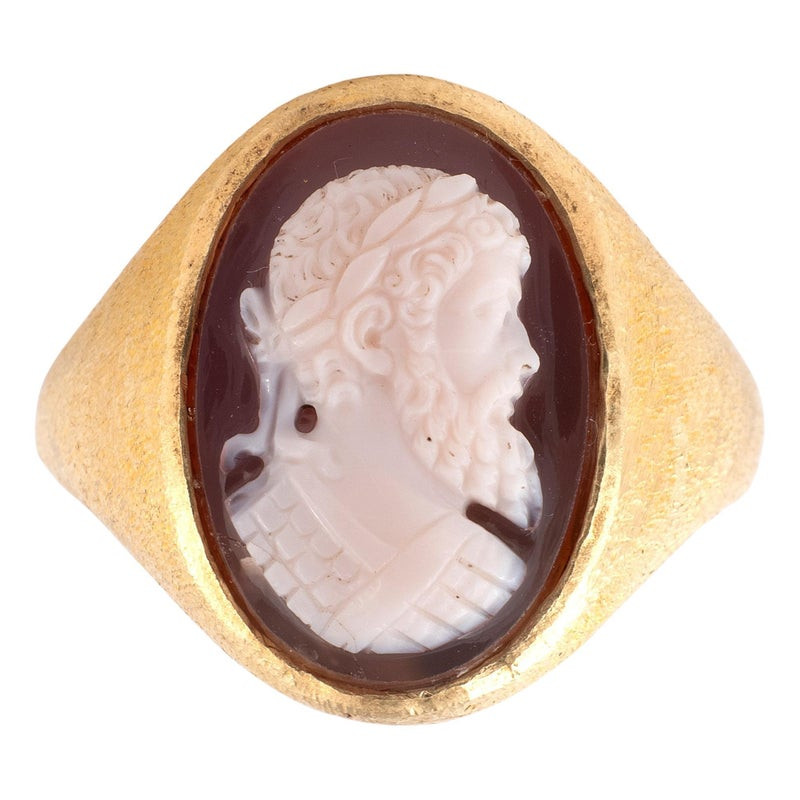
Questo raffinatissimo cammeo del XVI secolo raffigura il profilo dell’imperatore Carlo V, il quale regnò sul Sacro Romano Impero e sul ducato d’Austria dal 1519 al 1556, fu re di Spagna dal 1516 al 1556 e signore dei Paesi Bassi e del ducato di Borgogna dal 1506 al 1555. La sua personalità e il suo potere, dunque, vengono celebrati in questo cammeo in agata estremamente pregiato per la sua qualità incisoria: Carlo V è ritratto di profilo come gli antichi imperatori romani ed è rappresentato con dovizia di particolari, infatti, si notano le ciocche di capelli particolarmente definite, una resa realistica e naturalistica dei tratti somatici e una particolare attenzione alla resa dell’armatura; egli, inoltre, viene rappresentato con la corona d’alloro, simbolo di potere e successo desunto dall’antica cultura romana. Questo cammeo, incastonato in una montatura contemporanea in oro 18 carati, rappresenta un notevole esempio della lavorazione incisoria ripresa dalla tradizione romana durante il Rinascimento. Dopo la caduta dell’Impero Romano, l’arte della glittica non fu più praticata fino al Quattrocento e Cinquecento, quando vennero raggiunti livelli qualitativi prossimi agli standard antichi, sebbene mai completamente equiparati nel corso della storia dell’arte.
This highly refined 16th century cameo depicts the profile of Emperor Charles V, who reigned over the Holy Roman Empire and the Duchy of Austria from 1519 to 1556, was King of Spain from 1516 to 1556 and Lord of the Netherlands and the Duchy of Burgundy from 1506 to 1555. His personality and his power, therefore, are celebrated in this agate cameo which is extremely valuable for its engraving quality: Charles V is portrayed in profile like the ancient Roman emperors and is represented in great detail, in fact, the locks of particularly defined hair, a realistic and naturalistic rendering of the facial features and particular attention to the rendering of the armour; he, moreover, is represented with the laurel wreath, a symbol of power and success taken from ancient Roman culture. This cameo, set in a contemporary 18k gold setting, represents a notable example of the engraving workmanship taken up by the Roman tradition during the Renaissance. After the fall of the Roman Empire, the art of glyptic was no longer practiced until the Fifteenth and Sixteenth centuries, when quality levels close to ancient standards were reached, although never completely equated throughout the history of art.


You might also like
Period: 16th century
Dimensions: 17.5 mm
Ring Size: 8
Weight: 18 gr