
Period: II- III century A.D.
Ring size: 8
Weight: 7.4 gr
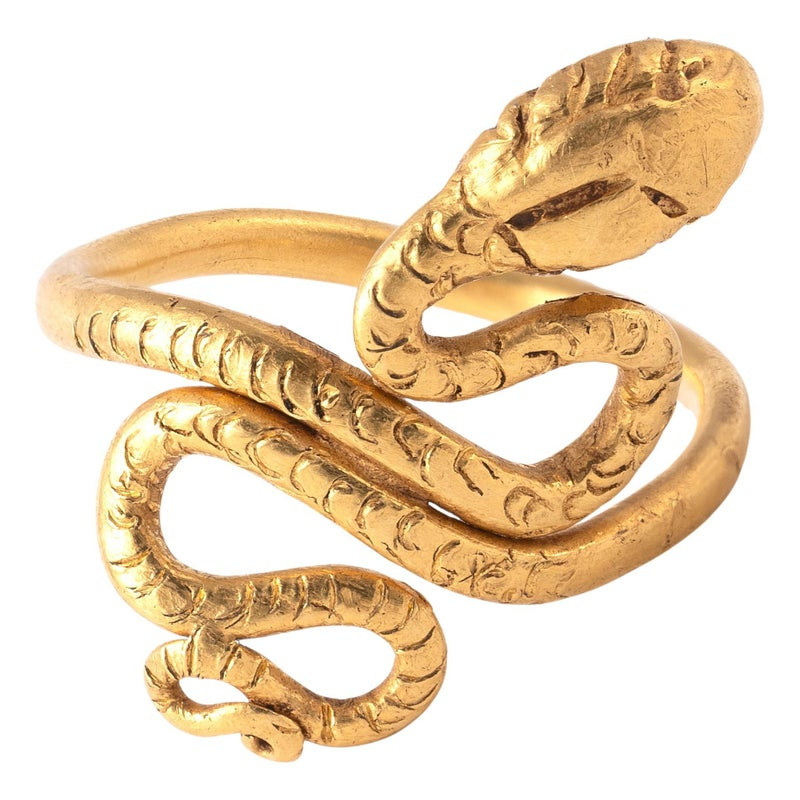
L’anello romano, databile tra il II e il III secolo, è realizzato in oro a 22 carati. Si tratta di un anello di elevata qualità, come si può notare dalla forgiatura del corpo e della testa dell’animale, il quale si presenta in ottime condizioni conservative. Il serpente, in particolare, era un’iconografa particolarmente diffusa già in epoca greca, quando era associato all’Agathodaimon (lett. Demone buono), il cui numen era proprio il serpente, con cui si mostrava alle persone per indicare la sua presenza e, quindi, era portatore di buon auspicio. Questo simbolo, però, trovò riscontro anche in epoca romana, dove l’Agathodaimon viene visto come un genius loci, quindi, un’entità divina legata a un luogo ed è così che il serpente assunse una funzione bene augurante e talismanica, prima di assumere una connotazione negativa in epoca cristiana e moderna.
The Roman ring, dating between the 2nd and 3rd centuries, is made of 22-carat gold. It is a high quality ring, as can be seen from the forging of the animal's body and head, which is in excellent conservative conditions. The serpent was a particularly iconography common already in ancient Greek, when it was associated with the Agathodaimon (lit. good Demon), whose numen was the serpent itself, with which it showed itself to people to indicate its presence and, therefore, was a bearer of good fortune. This symbol, however, also found confirmation in Roman times, where the Agathodaimon is seen as a genius loci, therefore, a divine entity linked to a place and this is how the serpent took on a well-wishing and talismanic function, before taking on a negative connotation in the Christian and modern era.


You might also like
Period: II- III century A.D.
Ring size: 8
Weight: 7.4 gr
