Period:Late 16th century
Finger size: 7
Weight: 3.4gr
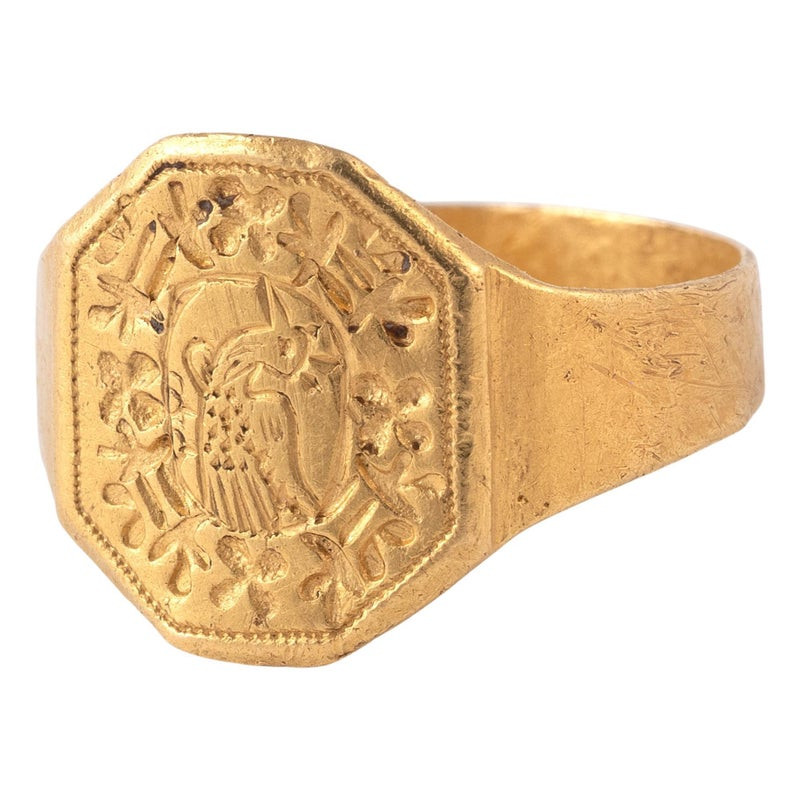
L’anello con sigillo del XVI secolo è forgiato in oro con una forma ottagonale che racchiude al suo interno l’incisione di un uccello, contornato da motivi ornamentali. La figura al centro potrebbe essere identificata con un pellicano, in araldica spesso associato all’amore di un buon pater familia nei confronti dei figli; altresì potrebbe trattarsi di un alcione – meglio conosciuto come martin pescatore – che in antichità si pensava potesse calmare la furia del mare in tempesta grazie al suo canto, pertanto, divenne simbolo di benevolenza e bontà d’animo. La forgiatura in oro del sigillo è indice del fatto che appartenne ad una persona facoltosa, la quale si avvalse di questo simbolo per identificare se stesso e la propria famiglia, sottolineando il proprio status sociale e, talvolta, la propria professione. Un anello simile, inoltre, è conservato presso il British Museum (AF.840).
The sixteenth century signet ring is forged in gold with an octagonal shape that encloses inside it the engraving of a bird, surrounded by ornamental motifs. The figure in the center could be identified with a pelican, in heraldry often associated with the love of a good pater familia towards their children; It could also be an alcione – better known as kingfisher – which in antiquity was thought to calm the fury of the stormy sea thanks to its singing, therefore, became a symbol of benevolence and goodness. The gold forging of the signet ring indicates that it belonged to a wealthy person, who used this symbol to identify himself and his family, emphasizing his social status and sometimes his profession. A similar ring is also kept at the British Museum (AF.840).


You might also like
Period:Late 16th century
Finger size: 7
Weight: 3.4gr