
Period: late XIX century
Ring size: 8 ½
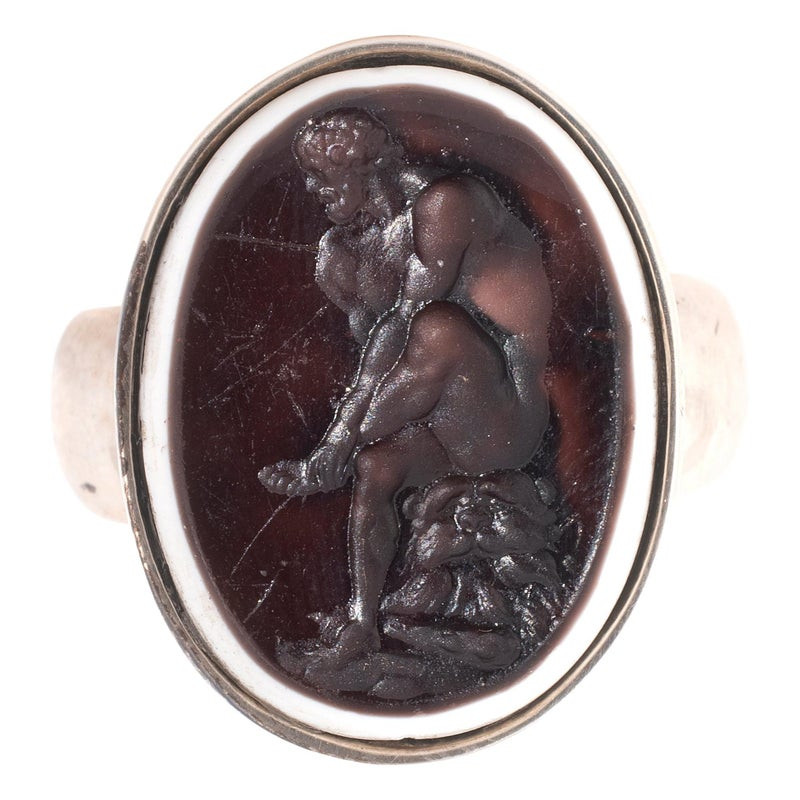
L’intaglio conserva una peculiare raffigurazione di Ercole intento a rimuoversi una spina dal piede. L’iconografia dell’eroe è deducibile, oltre dalla gagliardezza della muscolatura, dal fatto che l’uomo siede sulla testa di un leone, riconducibile alla prima fatica in cui Ercole dovette sconfiggere proprio il leone Nemea. L’eroe, inoltre, viene raffigurato con la bocca aperta in segno di sofferenza e richiama una scultura come quella di C. Weidizt in avorio, conservata presso il Victoria & Albert Museum di Londra (A.35-1949), dove Ercole viene però mostrato in età quasi infantile. In definitiva, si può affermare che l’iconografia di Ercole che si rimuove una spina dal piede è desunta dalla più antica scultura dello Spinario, dove un giovane è raffigurato nella stessa posa e di cui la versione più antica si conserva ai Musei Capitolini (inv. MC1186).
The carving retains a peculiar depiction of Hercules intent on removing a thorn from his foot. The iconography of the hero can be deduced, in addition to the vigor of his muscles, from the fact that the man sits on the head of a lion, attributable to the first effort in which Hercules had to defeat the Nemean lion. The hero is also depicted with his mouth open as a sign of suffering and recalls a sculpture such as that of C. Weidizt in ivory, preserved at the Victoria & Albert Museum in London (A.35-1949), where Hercules is shown at an almost infanciful age. Ultimately, it can be said that the iconography of Hercules removing a thorn from his foot is taken from the oldest sculpture of Spinario, where a young man is depicted in the same pose and of which the oldest version is preserved in the Capitoline Museums (inv. MC1186).


You might also like
Period: late XIX century
Ring size: 8 ½
