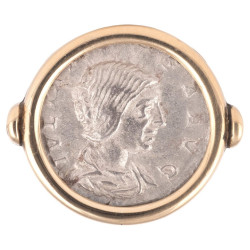



Description
Youthful head of female profile facing left.
Mounted in 18kt yellow gold
Top size 13mm x 11mm
Marseille, the "Massalia" of the Greeks, founded by the Phocians in 600 BC, arose from the Greeks' desire to establish trading posts to compete with the Carthaginians and Etruscans for dominance of the western Mediterranean. Marseille is by no means a Celtic or Gallic creation; it belongs to the Greek world.
Between the 5th and 1st centuries BC, Marseille and its hinterland experienced unprecedented growth.
The rise of Rome, beginning with the First Punic War (268-241 BC), and Marseille's strategic choice to ally with Rome against Carthage would restore Massalia to a leading role in international trade in the western Mediterranean in the second half of the 3rd century BC.
The 2nd century BC marked the decline of the Phocaean city. A favored ally of the Romans, Marseille, thanks to the Romans, succeeded in establishing its power in the Marseille hinterland. By stopping the Cimbri and Teutones, the Romans saved southern Gaul from invasion. From 118 BC onward, the situation changed, and the Province became a Roman province. Marseilles' merchants competed with Roman traders in Spain, Corsica, Sardinia, and Sicily. Nonetheless, they remained allies of the Romans until the 1st century BC.
The outbreak of the civil war between Caesar and Pompey in 49 BC proved fatal for the city. Marseilles could not choose between the two protagonists. Caesar besieged and conquered the city, unable to allow its lines of communication between Gaul and Italy to be cut. The Marseilles fleet was still too large to fall into the hands of its archenemy, Pompey. Although conquered, the city was not sacked and remained an important port in the early days of Roman rule. Remaining Hellenic, it was never completely assimilated into Roman Gaul and maintained a sort of independent status, imbued with cosmopolitanism, where all religions and peoples mingled, to the great advantage of Marseilles' trade.
Details
Period: Circa 350-220 BC
Size: 7
Weight: 6,82 gr
You might also like
Period: Circa 350-220 BC
Size: 7
Weight: 6,82 gr