Period: XVIII century.
Provenance: French, signed Haye.
Dimensions: 8 cm x 5,9 cm
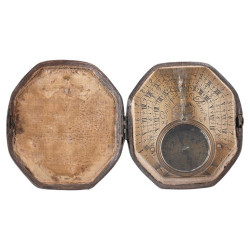
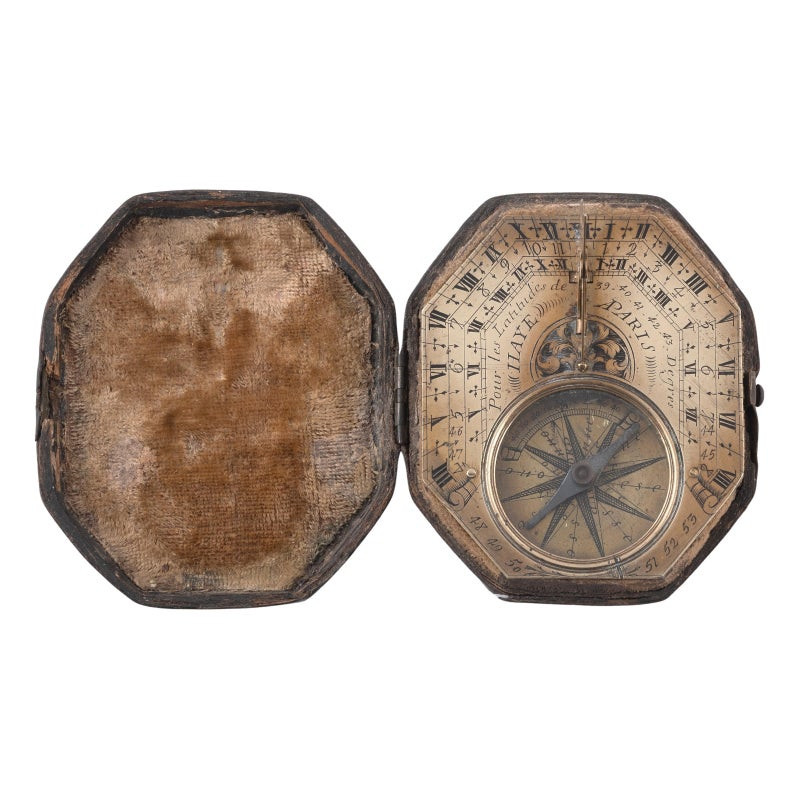
Signed HAYE A PARIS, octagonal brass dial engraved, inset compass, mounted with hinged gnomon with bird indicator.
Engraving of cities with their latitude. Dial in brown velvet lined fish skin covered case. 80mm x 45mm x 59mm
This type of portable sundial was a fashionable traveller's accessory during the late 17th century. The latitudes of towns in Europe including Paris, Rome, Venice, Madrid and Milan are engraved on the back. The hinged gnomon (triangular flap made to create a shadow) could be adjusted according to latitude. The gnomon folds flat and the sundial has cut corners to enable the dial to be enclosed in a case and carried in a pocket.
The adjustable gnomon enabled the time to be read accurately in a variety of locations. Travellers still carried sundials even when watches became popular. Early watches were not always accurate for long and a dial enable them to be set regularly. A German travellers' guide of the time also recommended sundials over clocks while on the road because the chiming of clocks might attract thieves.
Thomas Haye was a member of the Founders' Corporation in Paris. In 1716 he published a work on dialling entitled Regle horaire universelle pour tracer des cadrans solaire sur toutes sortes de plans reguliers, declinans & inclinez.


You might also like
Period: XVIII century.
Provenance: French, signed Haye.
Dimensions: 8 cm x 5,9 cm