Period: 19th century
Length: 46 cm
Weight: 50,5 gr
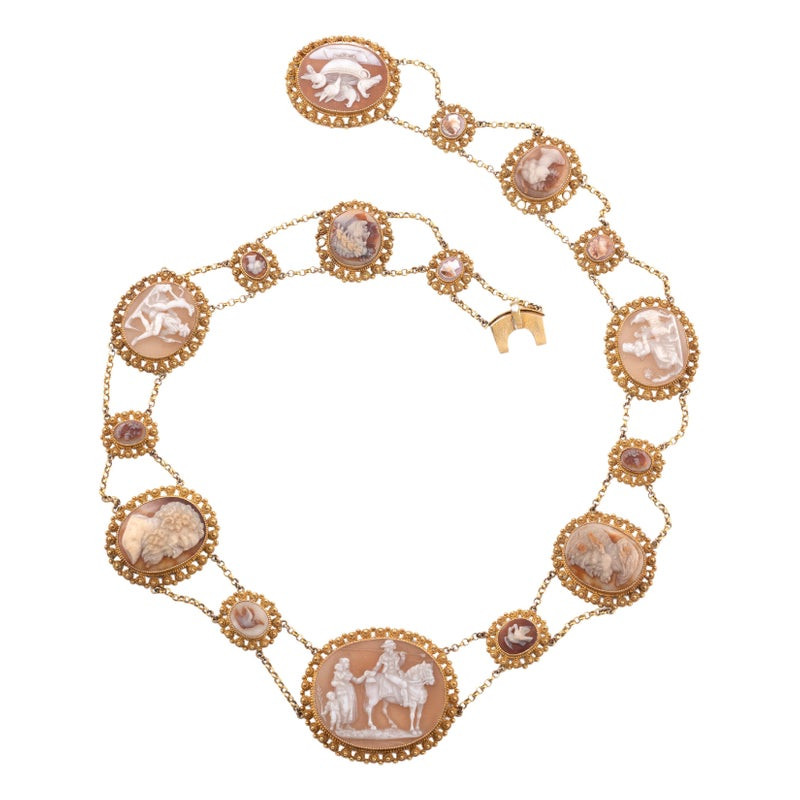
La collana, realizzata nel primo quarto del XIX secolo, è composta da sedici cammei in conchiglia, inseriti in una preziosissima montatura in oro giallo lavorata a filigrana, tecnica che conferisce eleganza e raffinatezza alla creazione. I cammei in conchiglia, per questo estremamente leggeri, presentano un’iconografia classicheggiante, in cui scene narrative si alternano a profili maschili e raffigurazioni di animali. Al centro, in particolare, si può riconoscere una scena di carità, ispirata dalla leggenda di San Martino, giacché si vede un uomo a cavallo che cede un sacchetto, presumibilmente colmo di denari, a una donna con i suoi due bambini. Un altro cammeo, invece, sembra rappresentare la figura mitologica di Diana cacciatrice, affiancata da un levriero, simbolo della caccia e del suo legame con gli animali selvatici e a cui segue un cammeo con la raffigurazione di una fontanella in cui si stanno abbeverando delle colombe. Ad unire questi cammei, però, vi è indubbiamente l’enorme qualità incisoria che ha permesso una resa estremamente naturalistica e dettagliata di tutte le raffigurazioni, come si può dedurre dalla finissima resa delle capigliature dei profili maschili, oltre che dalla complessità e accuratezza delle scene più ampie e narrative.
The necklace, made in the first quarter of the 19th century, is made of sixteen shell cameos, inserted in a very precious filigree-worked yellow gold frame, a technique that gives elegance and refinement to the creation. The shell cameos, therefore, extremely light, present a classical iconography, in which narrative scenes alternate with male profiles and depictions of animals. In the centre you can recognize a charity scene, inspired by the legend of San Martino, since you can see a man on horseback giving a bag, presumably full of money, to a woman with her two children. Another cameo, however, seems to represent the mythological figure of Diana the huntress, flanked by a greyhound, symbol of hunting and its connection with wild animals and followed by a cameo with the depiction of a fountain in which doves are drinking. What unites these cameos, however, is undoubtedly the enormous engraving quality which has allowed an extremely naturalistic and detailed rendering of all the depictions, as can be deduced from the very fine execution of the hair of the male profiles, as well as from the complexity and accuracy of the wider and more narrative scenes.


You might also like
Period: 19th century
Length: 46 cm
Weight: 50,5 gr