


Description
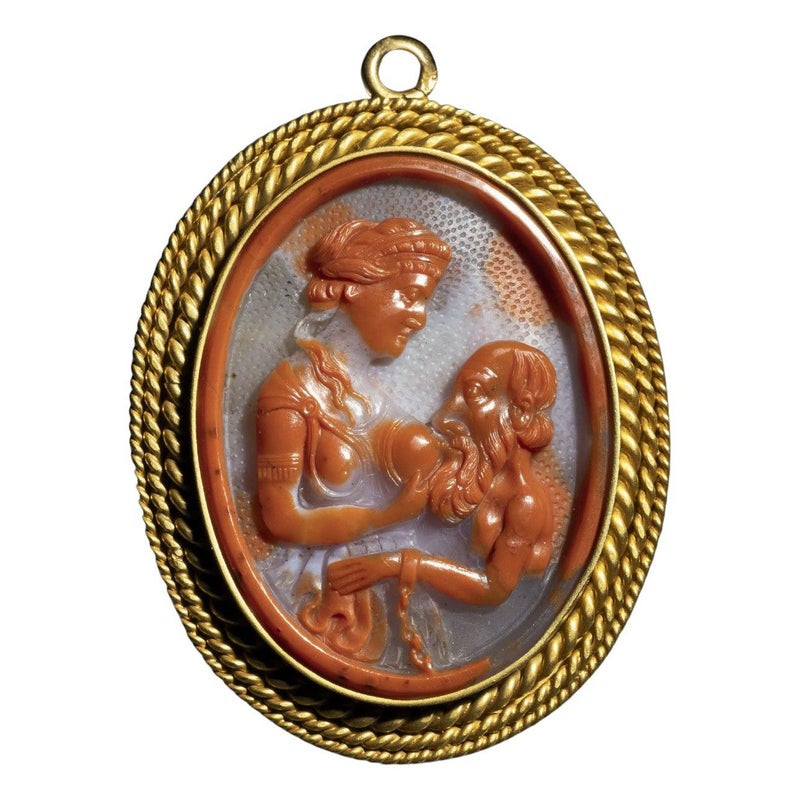
Il pendente è caratterizzato da un cammeo del XVI secolo in agata a due strati, rosso e bianco, e da una montatura databile al XIX in oro giallo 18 carati, come certificato dal punzone con la testa d’aquila, il quale potrebbe altresì indicarne la manifattura francese, dove questo simbolo fu largamente utilizzato a partire dalla fine degli anni ‘30. Il cammeo 500esco, di produzione italiana, raffigura la peculiare iconografia della Carità in cui una giovane donna allatta un uomo anziano, un’immagine desunta da un’antica leggenda romana raccontata in primis dallo storico Valerio Massimo in Factorum et dictorum memorabilium libri. Lo storico narra di una giovane di nome Pero che è stata scoperta mentre allattava il padre Cimone condannato a morte e, per questo, fortemente emaciato; la scena suscitò empatia nei confronti dei generali romani che decisero di liberare padre e figlia sebbene quest’iconografia divenne emblematica di uno dei princìpi più importanti della tradizione romana, ovvero la pietas, ossia la devozione nei confronti degli dei, della patria e della famiglia. Quello della Caritas romana, dunque, divenne un motivo estremamente rappresentato in arte da artisti di grandissima fama come Artemisia Gentileschi o Caravaggio, sebbene questo cammeo si presume abbia preso ispirazione da una lastra di smalto dipinta da Jean Pénicaud intorno al 1545, oggi conservata nella Walter Art Gallery di Baltimora (inv. 44.60).
The pendant is characterised by a 16th-century cameo in two-layered agate, red and white, and a 19th-century mount in 18-karat yellow gold, as certified by the eagle's head mark, which could also indicate its French manufacture, where this symbol was widely used from the end of 1830s. The 500th-century cameo, of Italian production, depicts the peculiar iconography of Charity in which a young woman breastfeeds an elderly man, an image taken from an ancient Roman legend told primarily by the historian Valerius Maximus in Factorum et dictorum memorabilium libri. The historian tells of a young woman named Pero who was discovered breastfeeding her father Cimon, condemned to death and, for this reason, severely emaciated; The scene aroused empathy towards the Roman generals who decided to free father and daughter, although this iconography became emblematic of one of the most important principles of Roman tradition, namely pietas, that consists in devotion to the gods, the homeland and the family. The Roman Caritas motif, therefore, became an extremely represented topic in art by artists of great fame such as Artemisia Gentileschi or Caravaggio, although this cameo is presumed to have taken inspiration from an enamel plate painted by Jean Pénicaud around 1545, today preserved in the Walter Art Gallery in Baltimore (inv. 44.60).
Details
Period: 16th century
Measurements (cameo): 3,7 x 2,9 cm
Weight: 25,6 gr
Length: 6,0 cm
You might also like
Period: 16th century
Measurements (cameo): 3,7 x 2,9 cm
Weight: 25,6 gr
Length: 6,0 cm