

Description
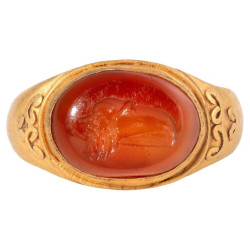
The Roman ring, dated to around the 3rd century, is characterised by an elaborate yellow gold setting in which is set a precious conical mottled sardonic, a specific variety of agate. In Roman times, agate could come from various destinations, such as Sicily, Egypt or India. Furthermore, around the 3rd century, there was an increase in the wealth of Roman society which allowed the creation of more opulent and ornate jewels, as in the case of this ring which features the shoulders of the stem forged in the shape of a palm leaf, also testifying the great goldsmith skill that had spread. Some examples are preserved at the British Museum in London (inv. 1917, 0501.297; 1879,0115.15) and it is possible to compare the following bibliography: Lucia Pirzio Biroli Stefanelli, L'oro dei Romani. Imperial Age Jewels, Rome 1992, p. 204, nos. 249-250; Alice and Louis Koch Collection in the Swiss National Museum, Zurich (Chadour, 1994, vol. 1, nos. 413-415 with further references, and 409).
Details
Period: 3rd century
Dimensions: 28 x 24 mm
Ring Size: 9 1/5
Weight: 10,35 gr
You might also like
Period: 3rd century
Dimensions: 28 x 24 mm
Ring Size: 9 1/5
Weight: 10,35 gr